
SCOARE Resources
Mentor Workshop Handouts
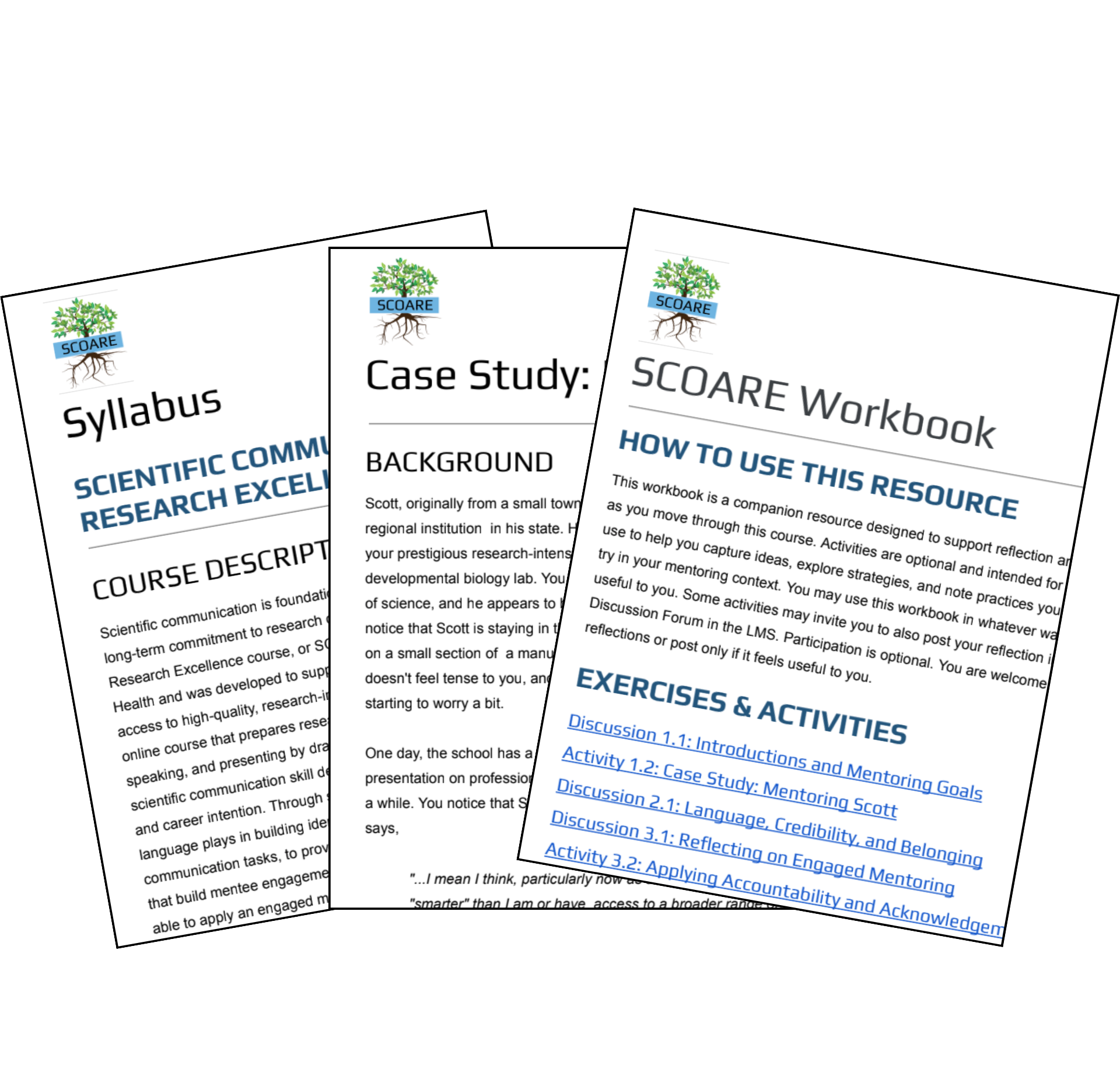
Refresher Course Materials
Scientific Communication Resources
-
ARTIFICIAL INTELLIGENCE (AI) TOOLS
Elicit: Use AI to search, summarize, extract data from, and chat with over 125 million papers.
ResearchRabbit: A citation-based literature mapping tool.
Consensus: A search engine that uses AI to find insights in research papers.
Scholarcy: Can summarize articles in most European languages. Users can find highlights, summaries, comparative analysis, and full text in the original language.
Alethea: Facilitates meaningful engagement with academic texts, class readings, and assignments through personalized and adaptive guidance. (Life Sciences section spun off in 2026.)
ARTIFICIAL INTELLIGENCE (AI) CREATING WRITING ASSIGNMENTS
AI Prompt Library : Can be used for use in classrooms to help instructors with preparation and teaching, created by Ethan Mollick
Working with AI: Two paths to prompting, by Ethan Mollick
AI-Generated text considerations for teaching & learning writing (University of Wisconsin-Madison collaborative document for faculty integration in teaching)
Quillbot: A grammar and writing checker that also provides summary, paraphrase, plagiarism checking, and good translation for 45 languages.
ChatGPT: Enables users to refine and steer a conversation towards a desired length, format, style, level of detail, and language.
Claude: An alternative to Chat GPT and is often described as generating text with more nuance and texture than Chat GPT.
RESOURCES
Academic Phrasebank (University of Manchester): Aims to provide you with examples of the phraseological ‘nuts and bolts’ of writing organised according to the main sections of a research paper or dissertation, as well as the more general communicative functions of academic writing.
Reducing Informality in Academic Writing (George Mason University): Language features that usually contribute to informality and examples of more formal alternatives from The Writing Center at GMU.
How to Improve your Writing through Freewriting Exercises (Peter Elbow)
The Thesis Whisperer: A blog dedicated to the topic of doing a PhD and completing a dissertation, managed and edited by Associate Professor Inger Mewburn (Director of Researcher Development, Australian National University). This set of slides [Your academic writing trouble (and how to fix it)] is particularly helpful.
Duke Graduate School Scientific Writing Resource: A general resources for scientific writing with lots of examples and problems for mentee to work on.
Joining a conversation: the problem/gap/hook heuristic (Lorelei Lingard, The Writers Craft Column, Perspectives on Medical Education): Tips and perspective on how to write a compelling introduction.
Organizing Your Research Paper: The C.A.R.S. [Creating A Research Space] Model (Research Guides, USC Libraries): Offers detailed guidance on how to develop, organize, and write a college-level research paper in the social and behavioral sciences.
Writing in the Sciences (Course SOM-Y0010, Stanford School of Medicine): This course teaches scientists to become more effective writers, using practical examples and exercises. Topics include: principles of good writing, tricks for writing faster and with less anxiety, the format of a scientific manuscript, and issues in publication and peer review. It is offered for free via Coursera.
Procrastinate Much? Manage Your Emotions, Not Your Time (Adam Grant, New York Times)
Are You Confused by Scientific Jargon? So Are Scientists (Katherine Kornei, New York Times)
RESOURCES FOR MENTORS
Teaching with Writing: Informal Writing Activities (Center for Writing, University of Minnesota): Brief activities designed to help students develop and distill their writable ideas and provide targeted revision practice that they can apply to their works in progress.
Teaching with Writing: Faculty Writing Groups/Retreats (Center for Writing, University of Minnesota): Tips and tricks for setting up writing groups/retreats.
Sample Email - Setting Up a Writing Retreat (SCOARE Resource)
Setting Up a Writing Critique Group (Tacey A. Rosolowski, The Write Stuff)
We Know What Works in Teaching Composition (Doug Hesse, The Chronicle of Higher Education): Students needed help developing and deploying their ideas and matching their writing with the expectations of various disciplines.
Learning to Improve: Using Writing to Increase Critical Thinking Performance in General Education Biology (Ian J. Quitadamo and Martha J. Kurtz, CBE-Life Sciences Education)
Why Kids Can’t Write: Some say English instruction must get back to basics, with a focus on grammar. But won’t that stifle a student’s personal voice? (Dana Goldstein, New
ANNOTATED BIBLIOGRAPHY TOOLS
Zotero: Free and open-source reference management software with multiple functionalities including sorting items into collections, tagging with keywords, and creating bibliographies.
Mendeley: Free reference management software that includes the ability to create a reference library, bibliographies, and collate your highlights and notes from multiple PDFs.
Perusall: E-reader for collectively annotating readings in threads, responding to each other’s comments, and interacting asyncronously.
OUTSOURCING GRAMMAR
Grammarly: An AI-powered writing assistant.
Microsoft Editor: Grammar, punctuation, capitalization, and spelling checker with free and premium versions.
Wordtune: An AI writing tool that rewrites, rephrases, and rewords your writing.
Hemingway Editor: This editor app highlights your texts in different colors to show errors and weaknesses as well as assesses its readability score for comprehension.
Purdue University’s Online Writing Lab (OWL): Another very helpful site offering guidance in grammar, paragraph organization, document organization, and more.
Grammar Bytes: Interactive grammar exercises.
Useful Words and Phrases (Lund University): Scaffolding writing tool with helpful guidance in various topics including grammar, paragraph organization, document organization, and more.
Don’t focus on English at the expense of your science (Zhanna Anikina, Nature Career Column)
Improving scientific communication with service, education and career development (Amanda Dicks, et al, Nature Biotechnology Career Feature): Description of a trainee-run editing program at Washington University in St. Louis.
Finding Writing Support for Trainees [video - see below; 11:14] (Jennifer Shade Wilson)
BOOK RECOMMENDATIONS
Engaging Ideas: The Professor’s Guide to Integrating Writing, Critical Thinking, and Active Learning in the Classroom, by John C. Bean
Academic Writing for Graduate Students: Essential Tasks and Skills(for mentees) and Commentary for Academic Writing for Graduate Students: Essential Tasks and Skills (for mentors), by John M. Swales & Christine B. Feak (especially good for non-native English speakers)
Telling a Research Story: Writing a Literature Review, by Christine B. Feak & John M. Swales
Writing to Learn, by William Zinsser
Scientific Writing, by Claus O. Wilke
A Short Guide to Academic Writing, by Andrew P. Johnson
Style: The Basics of Clarity and Grace, by Joseph M. Williams and Joseph Bizup
The Scientist's Guide to Writing: How to Write More Easily and Effectively throughout Your Scientific Career, by Stephen B. Heard
Becoming an Academic Writer: 50 Exercises for Paced, Productive, and Powerful Writing, by Patricia Goodson
Writing Your Dissertation in Fifteen Minutes a Day: A Guide to Starting, Revising, and Finishing Your Doctoral Thesis, by Joan Bolker
How to Fix Your Academic Writing Trouble: A Practical Guide, by Inger Mewburn, Katherine Firth, and Shaun Lehmann
Scientific Writing and Communication: Papers, Proposals, and Presentations, by Angelika H. Hofmann (addresses discipline, genre, rhetoric, and voice in the biosciences)
Essentials of Writing Biomedical Research Papers, by Mimi Zeiger (provides real, concrete examples of how to structure and restructure language for publication)
Writing Science: How to Write Papers That Get Cited and Proposals That Get Funded, by Joshua Schimel
Writing Your Journal Article in Twelve Weeks: A Guide to Academic Publishing Success, by Wendy Laura Belcher
Houston, We Have a Narrative: Why Science Needs Story, by Randy Olson
-
SPEAKING
Advocacy and Inquiry Idioms: Helpful ‘templates’ that encourage trainees to speak up.
How to Introduce a Speaker: Instructions to give trainees for introducing a seminar speaker.
Informational Interviewing: Sample email template to request an informational interview and interview questions. (SCOARE Resource)
Scientific Elevator Speeches: A Communication and Critical Thinking Tool (Erin Rieger, Puja Aggarwal, and Carrie Cameron, Medical Education)
How to Talk to People, According to Terry Gross (Jolie Kerr, New York Times)
Toastmasters: A nonprofit educational organization that teaches public speaking and leadership skills through a worldwide network of clubs.
The surprising secret to speaking with confidence [video - see below; 18:55] (Caroline Goyder, TEDxBrixton): In this fun and personal talk, Caroline, voice coach and author of Gravitas: Communicate with Confidence, Influence and Authority, shares a story of moving from stage-paralysis to expressive self.
PRESENTING
Scientific Presenting: Using Evidence-Based Classroom Practices to Deliver Effective Conference Presentations (Lisa A. Corwin, Amy Prunuske, and Shannon B. Seidel, CBE-Life Sciences Education)
Presentation Expressions: Helping people learn English presentation expressions and presentation tips for school or business since 2009.
The 1 Sentence That Will Make You a More Effective Speaker Every Time (Brenda Barbosa, Inc.com)
How to Nail Every Presentation, According to TED’s Top Speaking Coach (Scott Mautz, Inc.com)
9 Public Speaking Lessons From the World’s Greatest TED Talks (Carmine Gallo, Forbes)
TED Talks: The Official TED Guide to Public Speaking, by Chris Anderson (book)
How to Answer Questions After Your Presentation: A quick guide for a variety of post-presentation question scenarios.
SLIDE TIPS AND TRICKS
Slide:ology: The Art and Science of Creating Great Presentations, by Nancy Duarte
Resonate: Present Visual Stories that Transform Audiences, by Nancy Duarte
How to avoid death by Power Point [video - see below; 20:31] (David JP Phillips, TEDxStockholmSalon): PowerPoint tips from David Phillips, the leading Swedish figurehead in the art of making presentations.
Designing effective scientific presentations: Using PowerPoint and structuring your talk [video - see below; 42:08] (Susan McConnell, Stanford University)
-
EXPECTATIONS AND STRUCTURE
Accountability Strategies: SCOARE Mentor Workshop handout
Ten simple rules for developing a mentor-mentee expectations document (Kristyn S. Master and Pamela K. Kreeger, PLOS Computational Biology)
“My Ph.D. advisers expected weekly progress reports. I’m glad they did” (Pijar Religia, Science Careers Column)
Scientific Communication Yearly Progress Report (SCOARE Resource)
Calendly: A scheduling tool for organizing meetings with mentees.
The Pygmalion Effect: Proving Them Right (Farnam Street): The Pygmalion Effect is a powerful secret weapon. Without even realizing it, we can nudge others towards success. In this article, discover how expectations can influence performance for better or worse.
Zotero as a teaching tool for independent study courses, honors contracts, and undergraduate research mentoring ( Dyan E. Morgan, ASM Journals, Journal of Microbiology & Biology Education)
ACKNOWLEDGEMENT
Acknowledgement Strategies: SCOARE Mentor Workshop handout
The neuroscience behind appreciation | 90 Seconds w/ Lisa Kim [video - see below; 3:41] (Stanford Medicine): Two new studies led by Stanford Medicine researchers examined whether we work, behave and feel differently in virtual versus in-person interactions and what's going on in our brains. They found that while people generally worked just as effectively in both situations, online interactions tended to reduce a particular aspect of conversation known as turn-taking—switching speakers. In these virtual meetings, less turn-taking was linked to less positive feelings about the interaction.
FEEDBACK
Directive Versus Facilitative Feedback (University of Groningen)
Minimal Marking, Maximum Learning: Strategies for grading efficiently & effectively (Center for the Advancement of Teaching and Learning, Elon University)
Developing Feedback Resilience - webinar recording (NIH Becoming a Resilient Scientist Series, Unit 4)
GENERAL TIPS AND TRICKS
Engagement Strategies: SCOARE Mentor Workshop handout
The Supervision Whisperers: A blog dedicated to the topic of supervising a thesis, co-edited by Dr Inger Mewburn, founder of The Thesis Whisperer and Director of Research Training at the Australian National University and Dr Evonne Miller, Director of QUT Design Lab, Creative Industries at Queensland University of Technology.
The Art of Scholarly Mentoring (Robert Lefkowitz, Inside Higher Ed): Nobel Laureate Robert Lefkowitz shares 10 golden rules gleaned from a half century of mentoring hundreds of research trainees.
The surprising thing Google learned about its employees — and what it means for today’s students (Valerie Strauss & Cathy Davidson, Washington Post): Broad learning skills are the key to long-term, satisfying, productive careers.
-
RESEARCH ARTICLES
Essay content and style are strongly related to household income and SAT scores: Evidence from 60,000 undergraduate applications (Alvero, Giebel, Begre-Medhin, Antonio, Stevens & Domingue, 2021)
Language and Linguistics on Trial: Hearing Rachel Jeantel (and Other Vernacular Speakers) in the Courtroom and Beyond (Rickford & King, 2016)
[Note: After the second page the article gets rather technical; you can get the overview of what it’s about in the first 2 pages.]Language Matters: Considering Microaggressions in Science (Harrison & Tanner, 2018)
Feeling Like an Imposter: The Effect of Perceived Classroom Competition on the Daily Psychological Experiences of First-Generation College Students (Canning, LaCosse, Kroeper, & Murphy, 2019)
OTHER ARTICLES
Advancing scientific discourse in American Sign Language (Lualdi, Spiecker, Wooten & Clark, Nature Reviews Materials)
The Biases We Hold Against the Way People Speak (John McWhorter, New York Times)
-
PSYCHOSOCIAL ASPECTS OF LANGUAGE
An Ancient Solution to Our Current Crisis of Connection (John Bowe, Guest Essay, New York Times)
‘Don’t Lose Your Accent!’ (Ilan Stavans, Guest Essay, New York Times)
Everyone Has an Accent (Roberto Rey Agudo, New York Times)
What does your accent say about you? (Melissa Hogenboom, BBC): Accents can be subject to subtle forms of prejudice, but does that mean some are more appealing and trustworthy than others?
Sometimes ‘Proper’ Speech Isn’t ‘Correct’ Speech (John McWhorter, New York Times)
John McWhorter’s column and newsletter (New York Times): Dr. McWhorter, a Columbia University linguist, explores how race and language shape our politics and culture.
I Sound Like A Scholar [video - below; 3:10] (The Language & Life Project at NC State University): This short video showcases that scholars come from a variety of linguistic backgrounds and celebrates the diverse dialects of all of the student, faculty, and staff scholars at NC State.
Hark the Sound of Dialect Diversity at UNC-Chapel Hill [video - below; 9:39]: This video was created as part of an initiative supported by Thrive@Carolina that seeks to explore and promote dialect diversity and awareness on UNC’s campus.
GENERAL COMMUNICATION GUIDES
The MIT Communication Lab CommKit - A Peer-to-Peer Scientific Communication Resource for Graduate Students: A collection of guides to successful communication in the biological sciences, written by the MIT Broad Research Communication Lab Fellows.
Nature Education's Scitable module on scientific communication: Short presentations on giving oral presentations, slide design, and answering questions, as well as materials on writing scientific papers.
COMMUNICATING WITH NON-EXPERT AUDIENCES
Opinion: Finding the plot in science storytelling in hopes of enhancing science communication (Martinez-Conde & Macknik, PNAS): Storytelling and narrative can help communicate science to nonexperts and improve the odds of science communication success.
Guide for Communication (The Turing Way): This guide covers topics related to effective communication in research.
ComSciCon: The Communicating Science workshop organized by graduate students, for graduate students.
Alan Alda Center for Communicating Science: The Alda Center’s graduate and professional development programs help make science engaging and accessible.
DATA VISUALIZATION
Fundamentals of Data Visualization: A Primer on Making Informative and Compelling Figures (Claus O. Wilke)
The Visual Display of Quantitative Information (Edward R. Tufte)
-
The following research articles were written and published by the SCOARE team:
The role of scientific communication in predicting science identity and research career intention (2020)
Helping mentors foster trainees’ ability in scientific communication (2018)
Validation of a Scale for Mentoring Practices Specific to Scientific Communication among Trainees (2018)
Do you speak science? Dialect and its role in research training (2018)
Bridging the Gap: Working Productively with ESL Authors (2007)
Contact Us
Whether you have a question, an idea, or just want to say hello, feel free to reach out—we’re here to help.
Use the form to drop us a message, and we’ll get back to you as soon as we can.
To find out more information about our workshops, Contact us at SCOARE@mdanderson.org